


Overview
Makey Makey Classic
Products
Grades 3–8
Grade Level
30 minutes
Time Required
Plug and Play
Category
Difficulty
CSTA Standards
CCSS Standards
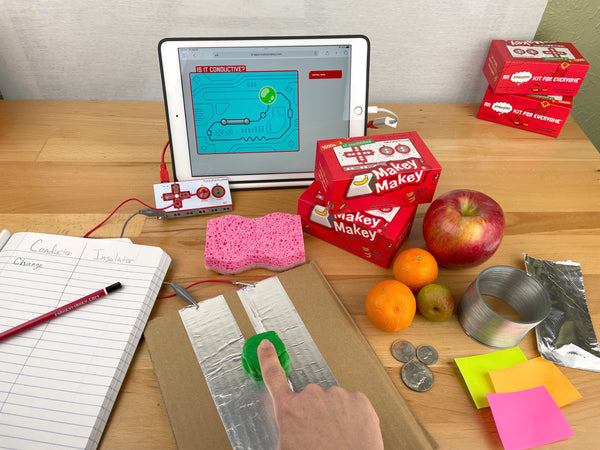
Explore the concept of conductivity by testing everyday materials with Makey Makey. Build a conductivity tester and discover which items around you can complete a circuit.
Learning Goals
- Define conductors and insulators
- Predict which materials will conduct electricity
- Test everyday objects for conductivity using Makey Makey
- Record and analyze results in a data table
Materials & Preparation
Materials Needed
- Makey Makey kit
- Alligator clips
- Various test materials (foil, fruit, coins, rubber, wood, paper, wet sponge, pencil lead)
- Recording sheet or notebook
Preparation
Set up Makey Makey stations with a variety of conductive and non-conductive items. Open a Makey Makey app (bongos or piano) on each computer. Prepare a recording sheet with columns for Material, Prediction, and Result.
Build Activity — Step by Step
Set Up Your Tester
Connect one alligator clip to EARTH and another to the SPACE input on Makey Makey. Open the bongo app on your computer.
Make Predictions
Look at each material and predict: will it conduct electricity? Record your predictions on the data sheet before testing.
Test Each Material
Hold the EARTH clip in one hand. Touch the SPACE clip to each material. If the bongo plays, the material is conductive!
Record Results
Write down whether each material was conductive or not. Compare to your predictions — were there any surprises?
Analyze Patterns
Look at your results. What do conductive materials have in common? Discuss metals, water, and graphite as common conductors.
Assessment
Students present their conductivity data tables, discuss surprising results, and explain the difference between conductors and insulators. Evaluate scientific method and data recording.