


Overview
Makey Makey Classic
Products
Grades 4–12
Grade Level
10–15 minutes
Time Required
Beginner Course
Category
Difficulty
CSTA Standards
CCSS Standards
Learn how a simple circuit works so you can create your first circuit and light your first LED! Build a paper circuit using conductive tape, an LED, and a coin cell battery.
Learning Goals
- Understand what a simple circuit is and how current flows in a loop
- Learn about conductors, insulators, and polarity
- Identify the positive and negative legs of an LED
- Build a working paper circuit from a template
Materials & Preparation
Materials Needed
- Simple Circuit printable template (PDF)
- Conductive fabric tape or aluminum foil
- 3V coin cell battery (CR2032)
- 5mm LED
- Scissors
- Scotch tape
Preparation
Print the Simple Circuit template for each student. Have conductive tape pre-cut in strips. Test a sample circuit to confirm LEDs and batteries work.
Build Activity — Step by Step
The Most Simple Circuit
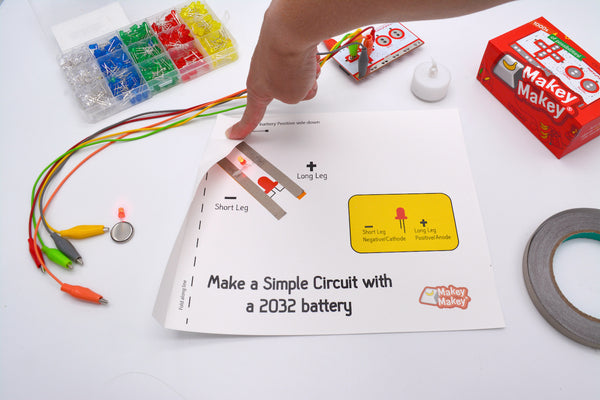
Hold an LED directly on a coin cell battery — long leg on positive (+) side. The LED lights up! This is the simplest possible circuit: a closed loop.
Check LED Polarity
Identify the long leg (positive/anode) and short leg (negative/cathode). If legs are trimmed, look for the flat spot on the LED rim — it marks the negative side.
Place Conductive Tape
Using the printed template, lay conductive fabric tape along the marked orange lines. These traces create the conductive paths for your circuit.
Position the LED
Bend the LED legs and place the longer positive leg on the positive trace and the shorter negative leg on the negative trace. Tape the legs down.
Add the Battery
Place the coin cell battery positive side down on the template. Fold the paper corner over the battery to connect both traces and complete the circuit.
Troubleshoot
If the LED doesn't light: check that traces don't cross (short circuit), verify LED polarity, and make sure the battery contacts are touching the traces.
Assessment
Students demonstrate a working paper circuit and explain current flow from the battery, through the LED, and back. They identify conductors vs. insulators and explain what polarity means.